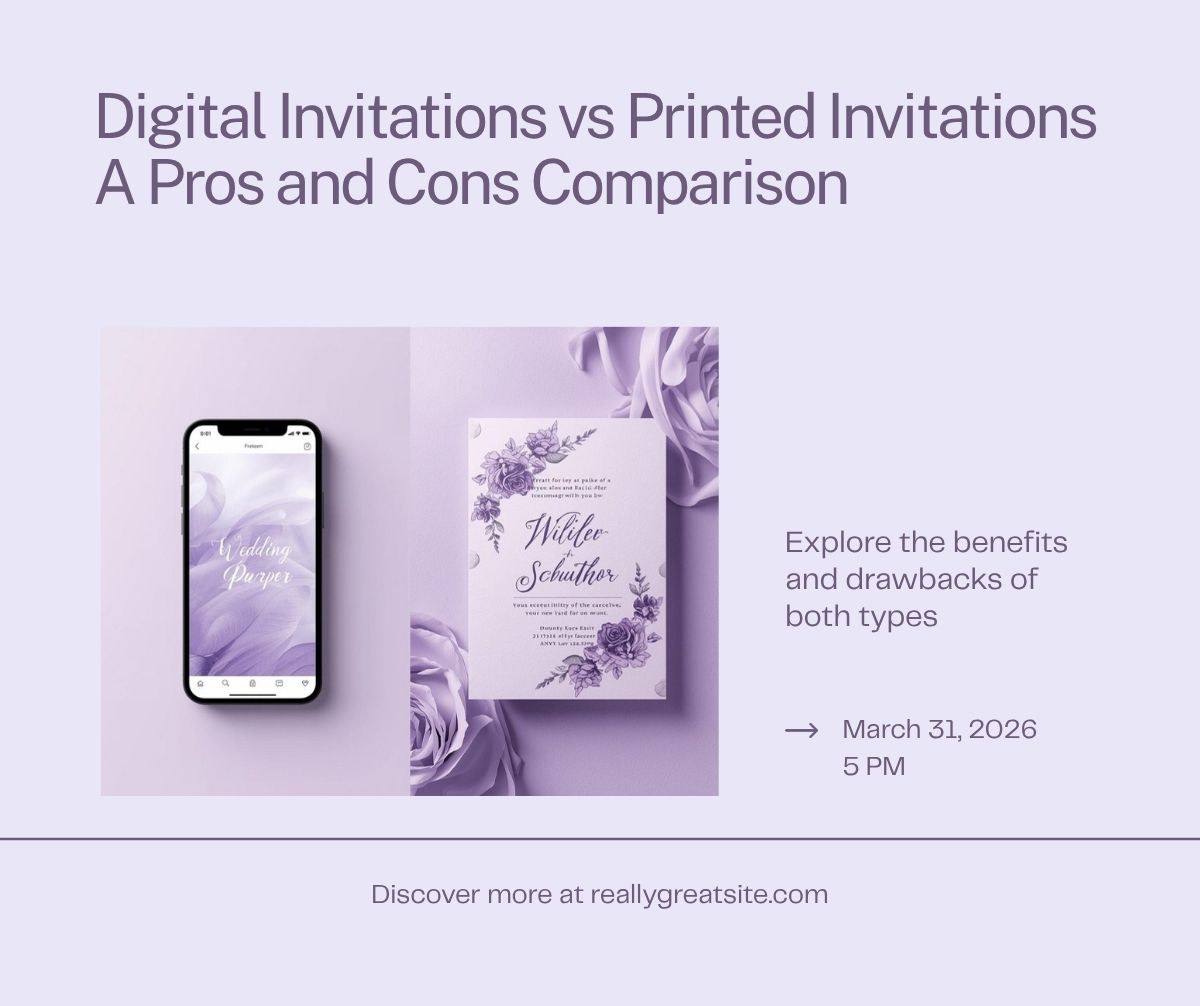
The debate between digital invitations vs printed is not really about which is better. It is about which fits your event, your guests, and your goals. Both options have real advantages and genuine drawbacks. Understanding each one helps you choose with confidence rather than default.
This breakdown covers cost, design quality, environmental impact, RSVP management, and guest experience for both options. By the end, you will know exactly which one to use and why.
Cost: Digital Invitations Win Every Time
Printed invitation costs add up fast. Paper quality, printing method, envelope style, postage, and quantity all drive the final number higher. A set of 100 wedding invitations with matching envelopes, inner envelopes, and RSVP cards can run from $300 to over $1,000 before you factor in postage.
Digital invitations cost little to nothing. Most platforms offer free tiers with professionally designed templates. Even paid plans rarely exceed $20 to $50 for unlimited invitations to an unlimited guest list. That is a significant cost difference for a budget-conscious host.
Hidden Costs of Printed Invitations
Beyond printing, paper invitations require addressing (by hand or with a calligrapher), assembling, stamping, and mailing. Each step takes time or money. Return address stamps, wax seals, and tissue paper inserts add further costs that seem small individually but accumulate quickly.
Reprints due to typos or address errors are common and expensive. With a digital invitation, you update and resend in seconds at no additional cost.
Design Quality and Customization
Printed invitations have a tactile quality that digital invitations cannot replicate. A letterpress card on thick cotton stock feels luxurious in the hand. Foil stamping catches the light in a way no screen can. For formal events where physical presentation matters, printed invitations make a statement.
Digital invitations offer a different kind of quality: interactivity. You can embed maps, countdown timers, photo galleries, music previews, and direct RSVP forms. A digital invitation can show an animation, link to a wedding website, and collect meal preferences simultaneously. A printed card cannot do any of that.
Template Availability
Both options offer extensive template libraries. For digital invitations, platforms like Invitofy provide professionally designed templates you can customize in minutes. For printed invitations, print-on-demand services offer similar flexibility but with a 5 to 10 day production and shipping wait.
If speed matters, digital wins outright. You can create and send a digital invitation the same day you decide to host an event. Printed invitations require lead time of at least 2 to 3 weeks minimum, often longer.
Environmental Impact
Printed invitations generate paper waste. For a wedding with 150 guests, that means 150 invitation envelopes, inner envelopes, RSVP envelopes, and whatever goes inside each one. Most of that ends up in recycling or landfill within a week of the event.
Digital invitations produce no physical waste. No paper, no ink, no shipping. For couples or event hosts who prioritize environmental responsibility, digital invitations are the clear choice.
According to the US Environmental Protection Agency, paper and paperboard account for a significant share of total municipal solid waste. Choosing digital invitations is a small but concrete step toward reducing that impact.
RSVP Management
This is where digital invitations decisively outperform printed ones. When you send a digital invitation with an embedded RSVP form, responses arrive automatically and instantly. You see exactly who is coming, who declined, and who has not yet responded, all in one dashboard.
Paper RSVP cards require guests to write their response, find an envelope, find a stamp, and mail it back. Every step in that chain is an opportunity for the RSVP to get lost, delayed, or forgotten. Average response rates for mailed RSVP cards are significantly lower than for digital RSVP forms.
Following Up on Non-Responders
With a digital invitation platform, you can see exactly which guests have not responded and send a targeted reminder with one click. With paper RSVPs, you do not know whether a non-response means the person lost their card, forgot to mail it, or simply is not coming. The ambiguity alone creates hours of follow-up work.
Guest Experience and Expectations
Guest expectations vary by age, culture, and event formality. For a formal wedding with older guests who value tradition, a beautifully designed printed invitation signals that you care about presenting the occasion properly. Some guests genuinely cherish paper invitations and keep them as mementos.
For younger guests, a digital invitation feels completely natural and expected. It is faster to open, easier to share with a partner, and simpler to respond to. A digital invitation link lives in a phone chat thread where guests can find the details again without searching through desk drawers.
When to Use Printed Invitations
Choose printed invitations for black-tie weddings and formal galas where tactile luxury is part of the guest experience. Use them for small events where the personal touch of a physical card matters, such as an intimate dinner party or a milestone anniversary celebration. Use them when your guest list skews significantly older and digital communication is less familiar or comfortable.
When to Use Digital Invitations
Choose digital invitations for any event where speed, budget, or RSVP tracking is a priority. Use them for casual to semi-formal events, large guest lists, events with international guests, or any occasion where you are planning with limited lead time. Digital invitations also work well as a supplement to printed invitations, giving guests an easy RSVP option even if you mailed a physical card.
The Best of Both Worlds
Many couples now use both. They send a beautifully printed save-the-date for the emotional impact, then follow up with a digital invitation that includes an embedded RSVP, map link, and wedding website connection. This hybrid approach gives guests the tangible experience they value while giving you the RSVP management convenience of digital tools.
For more on managing your guest list digitally, see the guide to tracking RSVPs online. For a step-by-step look at creating digital wedding invitations specifically, read the digital wedding invitations guide.